

-
English
-
 Español
-
 Português
-
 Русский
-
 Français
-
 日本語
日本語
-
 Deutsch
-
 Tiếng Việt
-
 Italiano
-
 Nederlands
-
 ไทย
ไทย
-
 Polski
-
 한국어
한국어
-
 Svenska
-
 Magyar
-
 Bahasa Melayu
-
 বাংলা
বাংলা
-
 Dansk
Dansk
-
 Suomi
Suomi
-
 हिन्दी
-
 Filipino
-
 Türkçe
-
 Gaeilge
-
 العربية
-
 Bahasa Indonesia
-
 Norsk
Norsk
-
 اردو
اردو
-
 Čeština
-
 Ελληνικά
-
 Українська
-
 Basa Jawa
-
 فارسی
فارسی
-
 தமிழ்
தமிழ்
-
 తెలుగు
-
 नेपाली
-
 မြန်မာ
-
 Български
-
 ລາວ
ລາວ
-
 Latina
-
 Қазақша
-
 Euskera
-
 Azərbaycan
-
 Slovenčina
-
 Македонски
-
 Lietuvių
-
 Eesti
Eesti
-
 Română
-
 Slovenščina

How does induction heating line for steel pipe quenching improve the comprehensive mechanical properties of carbon steel and alloy steel?
2026/07/21
With the continuous development of industries such as automobile manufacturing, machining, energy equipment, and construction machinery towards high performance and high reliability, the mechanical properties of carbon steel and alloy steel pipes have become important indicators for measuring product quality. Induction heating line for steel pipe quenching, leveraging advanced medium-frequency induction heating technology, intelligent temperature control systems, and automated quenching and tempering processes, achieves precise control over the entire process of steel pipe heating, cooling, and performance optimization. Through uniform heating, rapid quenching, and scientific tempering, the hardness, strength, wear resistance, and toughness of steel pipes can be effectively improved, enabling carbon steel and alloy steel to achieve superior comprehensive mechanical properties and meeting the application requirements of modern industry for high-quality steel pipes.
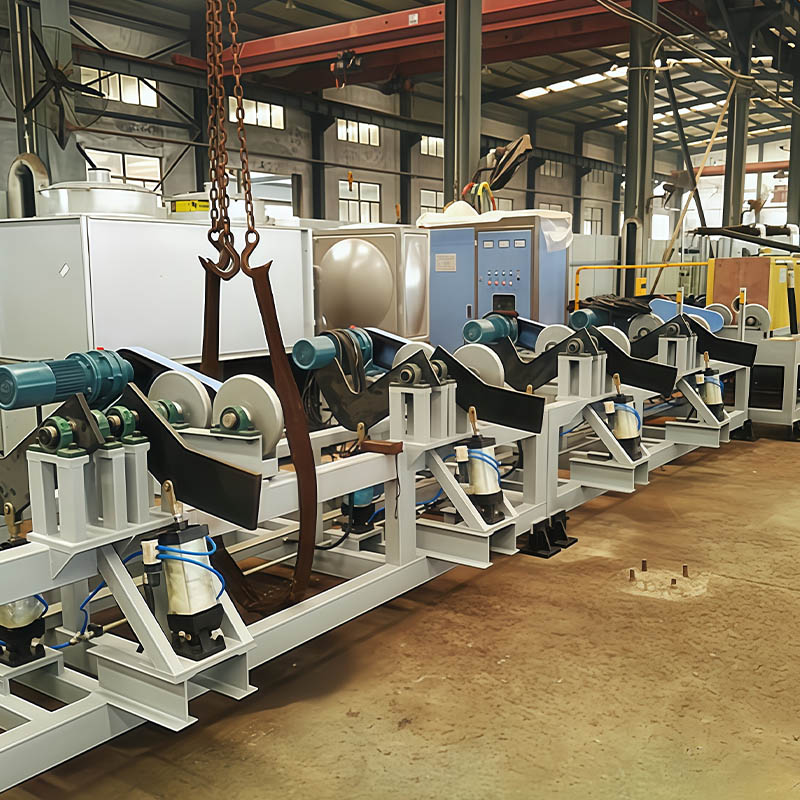
1. Medium-frequency induction heating achieves uniform microstructure strengthening
The key foundation for improving material properties through induction heating line for steel pipe quenching lies in the use of medium-frequency induction heating technology. The equipment utilizes electromagnetic induction to rapidly heat steel pipes, automatically adjusting the heating frequency and output power based on pipe specifications, wall thickness, and material. This ensures the pipes quickly reach the required temperature range for heat treatment, while avoiding localized overheating or underheating.
The production line is equipped with infrared temperature measurement devices to monitor the surface and core temperatures of the steel pipes in real time. A PLC control system automatically corrects heating parameters, ensuring uniform heating throughout the pipe. This uniform and stable heating process promotes complete transformation of the material's internal structure, creating favorable conditions for subsequent quenching and further improving the overall strength, hardness, and microstructure consistency of the steel pipe.
2. Quenching and Tempering Process Optimization for Comprehensive Mechanical Properties
After precise heating, the steel pipe immediately enters the quenching zone, where it is rapidly cooled by a high-efficiency spray cooling system. This forms a uniform and dense hardened layer on the surface, significantly improving the material's hardness, wear resistance, and compressive strength. This rapid and uniform quenching method effectively improves the surface properties of the steel pipe, making it more suitable for applications such as automotive parts, mechanical transmission systems, and high-load engineering equipment.
To further improve the overall performance of the materials, the production line is also equipped with a temperature-controlled tempering process. Tempering releases internal stress generated during quenching, reduces material brittleness, and improves the toughness, impact resistance, and crack resistance of the steel pipes, achieving a more reasonable balance between hardness and toughness. Through the synergistic treatment of quenching and tempering, carbon steel and alloy steel not only maintain high strength but also possess more stable long-term service performance, effectively extending product lifespan.
3. Automated Control Ensures Consistent Heat Treatment Quality
In addition to advanced heat treatment processes, the induction heating line for steel pipe quenching also features highly automated control capabilities. The system can automatically adjust the heating power, quenching time, and cooling rate according to different steel pipe specifications, ensuring consistent heat treatment quality across different batches. This effectively reduces errors caused by human operation, improving product consistency and finished product qualification rate. Simultaneously, the automatic discharge system and closed-loop cooling system enable continuous production, precisely controlling the cooling rate of the steel pipes to ensure stable and uniform cooling for each pipe, effectively reducing cooling water consumption and improving resource utilization efficiency.
Combining the advantages of medium-frequency induction heating, intelligent temperature control, automatic quenching and tempering, and efficient cooling, the induction heating line for steel pipe quenching can comprehensively improve the overall mechanical properties of carbon steel and alloy steel, providing more efficient, stable, and reliable heat treatment solutions for industries such as automobile manufacturing, machinery manufacturing, tool processing, and deep steel processing.